Somewhere between an agency retainer and a permanent hire there is an arrangement that suits a lot of companies better than either. It also suits a lot of companies worse, and the second part gets left out of most articles on the subject.
What the role actually is
A fractional SEO lead holds the ownership a head of SEO would hold, for a defined number of hours a month, without being on payroll. In practice that means:
- Setting direction — which markets, which pages, which order, and what you are deliberately not doing this quarter.
- Writing specifications your developers and writers can execute without interpreting them.
- Reviewing before things ship — migrations, templates, redirect maps, briefs. The reversible-cost review is most of the value.
- Owning the numbers, reporting against them honestly, and saying when something is not working.
- Being the person your team asks when a decision comes up mid-sprint and nobody knows the answer.
What it is not: production capacity. A fractional lead does not write forty pages or run an outreach desk. If that is what you need, you need a team, and anyone selling you sixteen hours a month as a substitute is misleading you.
The cost comparison, honestly
The three options at roughly comparable seniority:
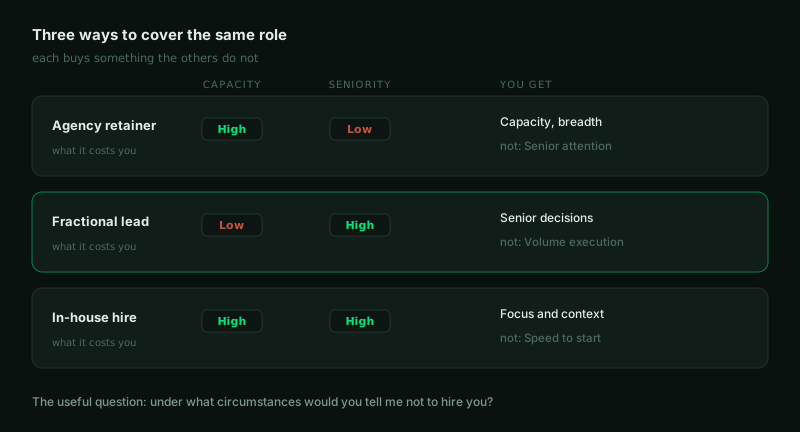
| Option | What you get | What you do not |
|---|---|---|
| Agency retainer | Capacity. A team that can produce, and cover for each other. Breadth across disciplines. | Senior attention. Much of your fee pays for account management and the agency's own business development. |
| In-house hire | Full-time focus, deep context, availability, and someone whose incentives are entirely yours. | Salary, recruitment, ramp-up and the risk of hiring the wrong person for a role you may not yet be able to evaluate. |
| Fractional lead | Senior decisions at roughly a third to a half of an agency retainer. No ramp-up, no recruitment. | Capacity. Hours are bounded, and it is direction rather than production. |
The saving is not magic. It comes from removing account management, new business time and overhead from the bill — and from the fact that the strategic part of SEO does not actually take forty hours a week in most organisations. Deciding what to do is a smaller job than doing it.
When it is the right answer
- You have people who can execute but nobody who can decide. The most common case. A content team, a developer, and no one able to say what to build first.
- You are between hires. Your SEO lead left, replacing them properly takes months, and momentum decays in the meantime.
- You are going international and need someone who has done it, but not permanently — the architecture decisions concentrate at the start.
- You are an agency that needs a specialist capability behind your own brand without hiring one. You keep the client relationship; the work gets done.
- You cannot yet evaluate an SEO hire. A fractional lead can also help you write the job spec and interview for it — which is a slightly strange thing to sell, since it ends the engagement.
You need volume, not direction. Forty pages have to be produced this quarter. That is a team, and a fractional lead will only slow you down while you pay them to tell you so.
Nobody internally can act. Direction with no execution capacity produces a stack of well-argued documents and no change in the numbers. This is the most common way the arrangement fails, and it is worth being blunt about before signing rather than after.
The work is genuinely full-time. If SEO is your primary acquisition channel at real scale, you need someone in the building. A fractional lead who will not tell you that is optimising for their own retainer.
How the engagement runs in practice
Sixteen hours a month, split roughly: a monthly strategy session with whoever owns the channel, a standing weekly window for reviews and decisions, and async availability in between with a 24-hour response policy on weekdays. Quarterly, a full priority reset against the actual data rather than the plan written three months earlier.
The part that tends to matter most is the review window. Most of the expensive mistakes in SEO are made in things that are hard to reverse — a migration, a URL structure, an architecture decision, a redirect map — and they are usually made quickly by someone who did not know it was a consequential decision. Having somewhere to send those before they ship is, in retrospect, where the money goes.
Getting a straight answer
If you are weighing this up, the useful question to ask any candidate is not what they would do for you. It is under what circumstances would you tell me not to hire you. Anyone who cannot answer that concretely has not thought about the limits of the arrangement, and those limits are exactly what you are trying to establish.
Mine are the three in the box above. The rates are on the offers page, and the discovery call is free precisely so this question can be settled before anyone commits.